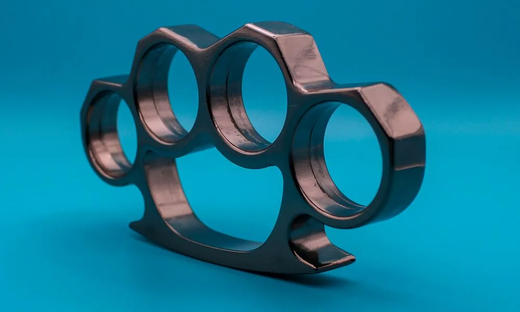
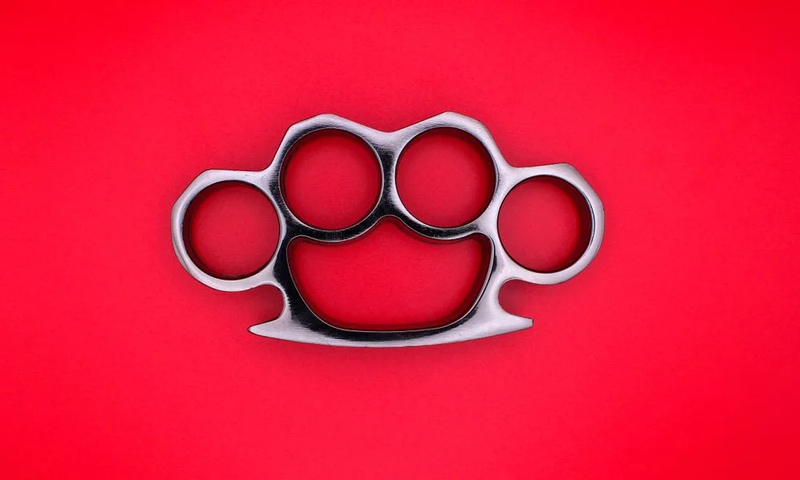
The federal list of prohibited weapons names brass knuckles directly and then widens the entry to similar devices. The rule on brass knuckles in Canada turns on details a person can check by looking at the object: what it is made of, how many fingers it fits, and whether it forms part of something else, such as the handle of a knife. The Canada Border Services Agency has published guidance on each of those points, including one material it says falls outside the definition. The Criminal Code supplies the possession offence and its maximum penalty.
Yes. Brass knuckles are a prohibited weapon in Canada. The regulation covers the device known as brass knuckles and any similar device made of a band of metal with one or more finger holes designed to fit over the fingers. Possessing one without a licence is an offence.
SOR/98-462 is the federal regulation that lists prohibited weapons. Part 3, item 15 reads:
“The device known as ‘Brass Knuckles’ and any similar device consisting of a band of metal with one or more finger holes designed to fit over the fingers of the hand.”
Section 84(1) of the Criminal Code defines a “prohibited weapon” to include, in paragraph (b), a weapon, other than a firearm, that is prescribed to be a prohibited weapon. Item 15 is a prescription of that kind, which is why the answer to whether brass knuckles are legal in Canada is no for anyone without a licence.
The entry has three working parts: the material, which is metal; the shape, a band with one or more finger holes; and the design, which is to fit over the fingers of the hand.
Metal knuckles, including two-finger half knuckles
The name says brass, but the material only has to be metal. Paragraph 43 of the CBSA’s Memorandum D19-13-2, dated 25 June 2026, says: “Brass knuckles can be made of any type of metal.” It adds that they are typically, but not exclusively, made with four finger holes, and that there are many variations.
One variation the memorandum names is “half knuckles,” which it describes as “a band of metal with only two finger holes.” Item 15 asks for “one or more finger holes,” so a two-finger band still fits the wording.
Are plastic brass knuckles legal in Canada?
The CBSA memorandum lists goods that “generally do not meet the definition of prohibited weapon,” and the first item is that “plastic knuckles do not fall within the definition of ‘brass knuckle’.” That matches the regulation, which describes a band of metal.
The same passage adds: “Their misuse may nonetheless be punishable under other laws.” Plastic knuckles generally sit outside item 15, but that says nothing about what happens if they are used on someone.
Brass knuckle knives
Paragraph 44 deals with knives whose handle is a set of brass knuckles. The memorandum says the blade does not generally make such a knife a prohibited weapon; it is the knuckle handle that will usually decide. A knife is prohibited on this basis only if the handle is effective as a weapon and that weapon meets the brass-knuckles definition. In the memorandum’s words: “It is not sufficient for the blade portion of the knife to be designed as a weapon.”
Possession of brass knuckles without a licence
Section 91(2) of the Criminal Code makes it an offence to possess a prohibited weapon without a licence under which the person may possess it. Under section 91(3)(a), the offence can be prosecuted as an indictable offence with “imprisonment for a term not exceeding five years,” or it can proceed by summary conviction.
That is the practical sense in which brass knuckles are illegal in Canada: the offence is having them without a licence, whether or not they were ever used. Section 91(4) sets out two exceptions within the section itself: possession under the direct and immediate supervision of someone who may lawfully possess the item, for a use that person may lawfully make of it, and coming into possession by operation of law and then, within a reasonable period, lawfully disposing of it or obtaining a licence. Personal protection is not one of them.
If brass knuckles are used on someone
Whether brass knuckles are illegal in Canada is a question about possession. Using them on a person is a separate matter. Someone accused of striking another person while wearing them may face a charge such as
assault with a weapon
, which turns on the facts of what happened. The plastic exception concerns the regulation’s definition and does not speak to that charge.
Frequently asked questions about brass knuckles in Canada
Yes. The rules in this article come from federal law, the Criminal Code and a federal regulation, so they apply in Ontario and Toronto as they do across the country. Metal knuckles fit Part 3, item 15 of SOR/98-462 wherever they are kept.
Not without a licence. Possessing a prohibited weapon without a licence is an offence under section 91(2), and the two exceptions in section 91(4), supervised possession and possession by operation of law, do not include personal protection.
The CBSA memorandum on importing weapons and devices says goods that fall within the Criminal Code definition of a prohibited weapon are classified under tariff item 9898.00.00 of the Customs Tariff, the tariff item it uses for prohibited goods.
Under section 91(3), possession without a licence can be prosecuted by indictment, with imprisonment for a term not exceeding five years, or by summary conviction.
This article is general information about Canadian law, not legal advice. Every case depends on its own facts. If you have been charged, speak with a criminal defence lawyer about your situation.