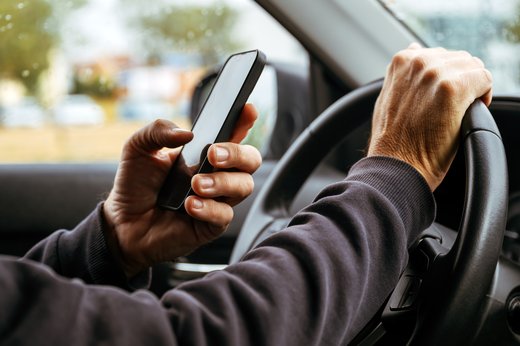
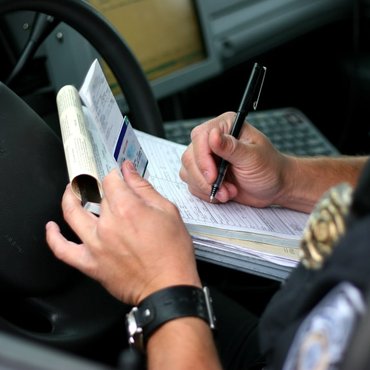
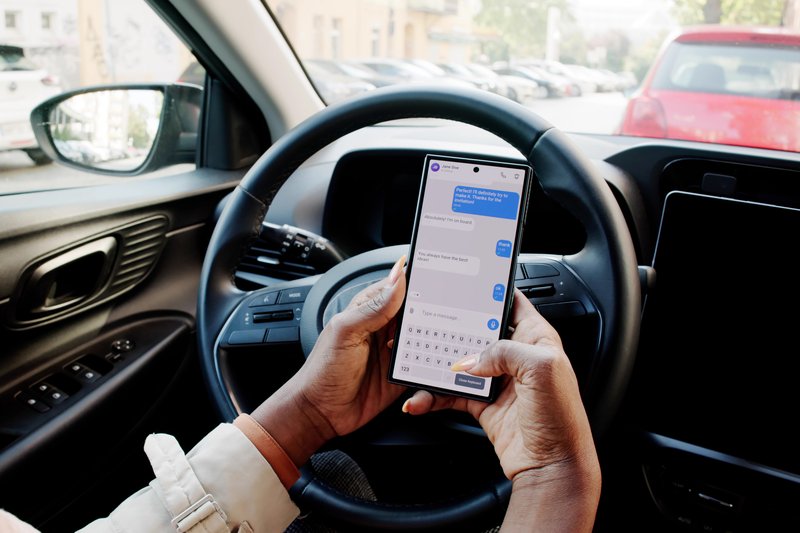
Distracted driving in Ontario includes any activity that takes your hands, eyes, or attention away from driving, and even holding a phone at a red light can result in a charge.
Penalties are strict and escalate quickly, including fines, demerit points, licence suspensions, and long-term increases in insurance premiums.
Key Takeaways
-
Distracted driving remains one of the leading causes of collisions in Ontario
-
Using or even holding a phone while driving is illegal, including at red lights.
-
First-time offences can result in fines up to $1,000, 3 demerit points, and a licence suspension.
-
Repeat offences carry longer suspensions and higher fines.
-
A conviction can significantly increase insurance premiums.
-
Many drivers are charged based on officer observation alone.
-
Legal defence often depends on a technical interpretation of the law and evidence.
Distracted driving remains one of the most aggressively enforced traffic offences in Ontario. While public awareness has increased over the years, enforcement has also intensified, and the legal definition of distraction remains broader than most drivers expect.
In 2026, distracted driving is no longer viewed as a minor traffic infraction. It is treated as a serious road safety issue, with penalties designed to deter even momentary lapses in attention.
Why Distracted Driving Remains a Major Risk in Ontario
Despite years of public campaigns, distracted driving continues to contribute to a significant portion of serious collisions.
Research from organizations such as
CAA National
consistently shows that:
-
drivers using mobile devices are multiple times more likely to be involved in a crash,
-
reaction times can be comparable to or worse than those of impaired driving,
-
and even brief glances away from the road significantly increase the risk of a collision.
Ontario road safety data has also shown that distracted driving:
-
contributes to a large share of fatal and injury collisions,
-
disproportionately affects urban areas with heavy traffic,
-
and is particularly common among younger drivers.
The key issue is not just prolonged distraction; it is momentary inattention at critical moments, such as braking, turning, or reacting to pedestrians.
What Counts as Distracted Driving in Ontario?
Ontario law defines distracted driving broadly. It is not limited to texting or calling.
The core principle is simple:
If your hands, eyes, or attention are not fully on driving, you may be at risk of a charge.
Use of Handheld Electronic Devices
This is the most commonly enforced category.
It includes:
-
texting or messaging,
-
dialing or answering calls,
-
scrolling or using apps,
-
holding a phone for any reason, even briefly.
Important:
You can be charged
even if the vehicle is stopped at a red light
. The law applies whenever the vehicle is in traffic, not just when it is moving.
Interacting with Mounted Devices
Even mounted devices (GPS units, phones) can incur charges if used improperly.
Permitted:
-
brief, minimal interaction (e.g., tapping once to accept navigation)
Risky:
-
prolonged interaction,
-
typing or searching,
-
repeated adjustments.
The distinction is often based on officers' observations and interpretations.
Distracted driving is not limited to electronics.
You can be charged for:
-
eating or drinking while driving,
-
reaching for objects,
-
adjusting controls in a way that affects attention,
-
interacting with passengers in a way that compromises control.
The key factor is whether the activity interferes with safe operation.
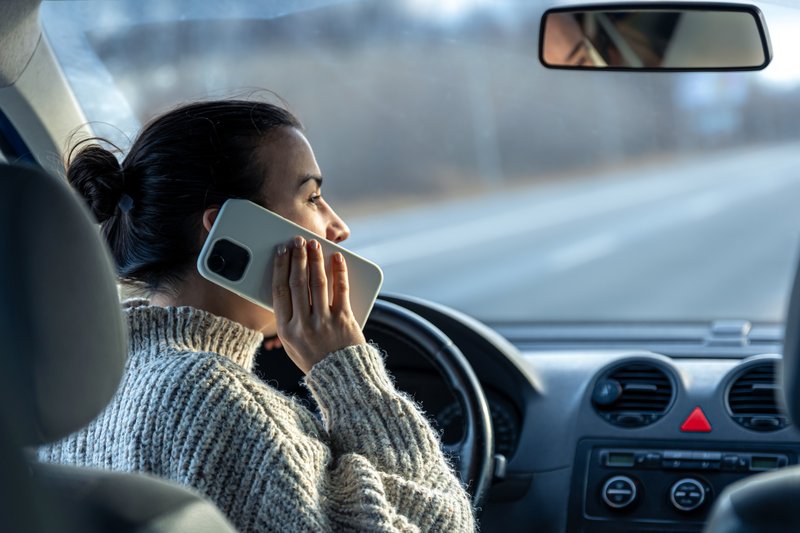
Penalties for Distracted Driving in Ontario (2026)
Penalties are structured to escalate with repeat offences.
|
Offense Count
|
Fine
|
Suspension
|
Demerit Points
|
|
First
|
Up to $1,000
|
3 days
|
3 points
|
|
Second
|
Up to $2,000
|
7 days
|
6 points
|
|
Third and Beyond
|
Up to $3,000
|
30 days
|
6 points
|
Additional consequences include:
-
increased insurance premiums,
-
possible policy non-renewal after multiple offences,
-
employment impact for drivers who rely on a licence.
The Hidden Cost: Insurance and Long-Term Consequences
While fines and suspensions are immediate, the long-term financial impact is often more significant.
A distracted driving conviction can:
-
increase insurance premiums for several years,
-
contribute to classification as a higher-risk driver,
-
affect eligibility for preferred insurance rates.
For repeat offences, insurers may:
-
refuse renewal,
-
require placement in higher-cost insurance categories.
This is similar in impact, though not identical, to consequences seen in impaired driving cases.
Are There Any Exceptions?
Ontario’s distracted driving laws are intentionally strict, and exceptions are narrow and interpreted conservatively by courts and police. Many drivers assume there is more flexibility than actually exists, which often leads to charges.
Below is a more detailed breakdown of what is (and is not) allowed.
Emergency Situations
Ontario law allows drivers to use a phone only for genuine emergency purposes, most commonly to contact emergency services (911).
However, this exception is very limited and applies only when:
-
there is an
immediate risk to safety
,
-
the call is
necessary and time-sensitive
,
-
and there is
no reasonable alternative
, such as pulling over first.
Examples that may qualify:
-
reporting a serious collision,
-
calling for urgent medical assistance,
-
reporting an immediate threat to public safety.
Situations that typically
do NOT qualify
:
-
calling a friend or family member for help,
-
reporting a non-urgent issue,
-
checking directions or traffic conditions.
Courts look closely at whether the situation was truly urgent. If it was not clearly an emergency, the defence may fail.
Fully Parked Vehicle
Drivers are allowed to use electronic devices only when the vehicle is fully and safely parked.
This means:
-
the vehicle must be completely out of active traffic,
-
it must be in a safe and lawful location,
-
and it must not pose a risk to other road users.
Examples of acceptable situations:
-
parked in a parking lot,
-
parked in a designated parking space on the street,
-
stopped in a legal lay-by or rest area.
What does
NOT count as “parked”
:
-
stopping at a red light or in traffic,
-
pulling over temporarily to the shoulder of a busy road,
-
stopping in a live lane, even briefly.
A common mistake is assuming that “not moving” equals “parked.”
Legally, it does not. If you are still part of the traffic flow, the law still applies.
Hands-Free Use
Hands-free systems are permitted, but only under strict conditions.
Allowed:
-
using Bluetooth for calls,
-
voice commands (e.g., Siri, Google Assistant),
-
a single tap to activate or answer a function.
Not allowed (or high-risk):
-
typing, scrolling, or entering information,
-
repeated or prolonged interaction with a device,
-
adjusting a device in a way that diverts attention from driving.
The key legal standard is whether the interaction is
“minimal and does not interfere with driving.”
Even with hands-free systems, a driver can still be charged if:
-
their attention is clearly diverted,
-
their driving behaviour is affected (e.g., drifting lanes, delayed reactions),
-
or the interaction goes beyond brief and simple use.
In practice, courts assess:
-
duration of interaction,
-
complexity of the action,
-
and its impact on driving control.
Common Mistakes Drivers Make
Many distracted driving charges arise from misunderstandings.
Typical assumptions that lead to charges:
-
“I was only holding my phone for a second.”
-
“I was stopped at a red light.”
-
“I wasn’t texting, just checking something.”
These are
not valid defences
under Ontario law.
How Distracted Driving Charges Are Proven
Unlike many criminal offences, distracted driving charges often rely heavily on officer observation.
An officer may testify that they observed:
-
a device in your hand,
-
your attention is diverted from the road,
-
behaviour inconsistent with safe driving.
There is often:
-
no video evidence,
-
no phone records required,
-
no need to prove actual texting or calling.
This makes these cases highly dependent on:
-
credibility,
-
clarity of observation,
-
and legal interpretation.
Defending Against Distracted Driving Charges
A charge does not automatically mean a conviction.
Effective defence strategies often focus on:
Challenging the Officer’s Observations
-
Was the object actually a phone?
-
Was it being used or merely held?
-
Was visibility clear?
Small inconsistencies can be significant.
Lack of Sufficient Evidence
-
No proof of interaction with a device
-
No clear indication of distraction affecting driving
Legal Interpretation of “Use”
Ontario law distinguishes between:
-
holding a device, and
-
actively using it.
The exact facts matter.
Exceptions and Context
-
Emergency use
-
Properly mounted device usage
Each case depends on detailed circumstances.
Practical Tips to Avoid Charges
Avoidance is straightforward in principle but requires discipline:
-
set navigation before driving,
-
enable “Do Not Disturb While Driving” modes,
-
keep your phone out of reach,
-
avoid eating or multitasking behind the wheel,
-
pull over safely if you need to interact with anything.
These are not just safety measures; they are legal protection strategies.
Why Distracted Driving Charges Should Be Taken Seriously
Many drivers underestimate the seriousness of distracted driving offences because they are not criminal offences.
However, the impact can be significant:
-
financial penalties,
-
licence suspensions,
-
insurance consequences,
-
long-term driving record implications.
For some individuals — particularly those who rely on driving for work — even a single conviction can have outsized consequences.
Speak with a Toronto Traffic or DUI Lawyer About Your Case
If you have been charged with distracted driving in Ontario, it is important to understand that these cases often depend on technical details and legal interpretation.
The Mass Tsang LLP team of
Toronto defence lawyers
represents clients facing a wide range of driving-related offences, including distracted driving and impaired driving cases. Their approach focuses on reviewing the evidence, challenging the basis of the charge, and developing a defence strategy tailored to the specific circumstances.
If you are looking for a traffic or
DUI lawyer
in Toronto or need guidance on how to respond to a distracted driving charge, seek legal advice before proceeding.
FAQ
Can you get a distracted driving ticket at a red light in Ontario?
Yes. Holding or using a phone at a red light is still considered distracted driving.
What is the fine for distracted driving in Ontario?
Fines can reach up to $1,000 for a first offence and increase for repeat offences.
Does distracted driving affect insurance?
Yes. A conviction can increase premiums and affect your risk classification.
Are hands-free devices allowed?
Yes, but only with minimal interaction and without affecting driving.
Can you fight a distracted driving ticket?
Yes. Many cases depend on officer observation and can be challenged.
Is eating while driving illegal in Ontario?
It can lead to a charge if it interferes with your ability to drive safely.
How many demerit points for distracted driving?
3 points for a first offence and 6 points for repeat offences.
Should you hire a lawyer for a distracted driving charge?
Yes. Legal advice can help assess evidence and improve your chances of a favourable outcome.