Can You Smoke Cigarettes While Driving in Ontario?
Rate this article
4
votes —
5.0
Updated:
1 month ago
Views:
14411
Ontario law does
not
impose a blanket ban on smoking cigarettes while driving. Whether smoking or vaping in a vehicle is lawful depends on the statute that applies — mainly the
Smoke-Free Ontario Act, 2017
, cannabis rules, and the
Highway Traffic Act
— not on intuition.
Conduct that looks lawful at first glance can still lead to provincial offences, careless-driving charges, or fines — especially where a minor is present, cannabis is involved, or smoking interferes with safe driving.
This article explains when smoking while driving is lawful, when it is prohibited, and when smoking can still support a charge even without a dedicated “no smoking while driving” ban. It is about provincial vehicle and traffic rules — not impaired driving / Over 80 offences.
Key Takeaways
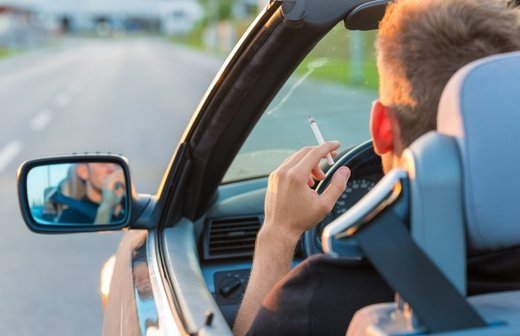
Smoking cigarettes while driving in Ontario is
not inherently illegal
, but it is subject to clear statutory restrictions.
It is
prohibited
to smoke or vape in a motor vehicle when a person
under 16
is present.
Smoking or consuming
cannabis
in a vehicle is illegal when a person has care or control of that vehicle.
Smoking may support a
careless driving
charge if police believe it interfered with safe vehicle operation.
Discarding cigarette butts from a vehicle is
littering
and can attract provincial or municipal fines.
The
Smoke-Free Ontario Act, 2017 (SFOA)
is the primary statute governing smoking and vaping in Ontario. While its main purpose is to protect people from second-hand smoke and vapour, it expressly regulates conduct inside motor vehicles in defined circumstances.
Smoking in a Vehicle with a Minor
Section 12 of the SFOA prohibits smoking or vaping in a motor vehicle if a person under the age of
16
is present, whether the vehicle is moving or parked.
Key points:
The prohibition applies even if the windows are open.
It applies on public roads and private property.
Both smoking and vaping are captured.
Enforcement does not require proof of impairment or unsafe driving.
A conviction carries a set fine (commonly cited at
$250
, plus court costs and the victim surcharge — confirm the current set-fine schedule for your court location).
“The legislature removed discretion here. If a minor is present, smoking in a vehicle is an absolute offence. Police do not need to show danger, distraction, or impairment.”
—
Heather Spence, Criminal Defence Lawyer & Partner
Cannabis and Smoking in Vehicles
Cannabis is treated differently from tobacco.
Under the SFOA and Ontario’s cannabis legislation, smoking or consuming cannabis in a vehicle is prohibited if a person has
care or control
of that vehicle. This can apply even when the vehicle is parked.
Separately, cannabis use in a vehicle may trigger a
criminal impaired-driving investigation
if police observe signs of impairment. That criminal pathway is outside the scope of this provincial smoking article; the point here is that cannabis-in-vehicle rules are stricter than tobacco rules.
Is Smoking Cigarettes While Driving Otherwise Legal?
Where no minor is present and no cannabis is involved, smoking cigarettes while driving is
not expressly prohibited
by Ontario statute. The SFOA’s motor-vehicle restrictions are focused primarily on situations involving minors. From a purely statutory standpoint, an adult smoking tobacco alone in a vehicle does not commit an SFOA offence.
Legality under the SFOA does not end the analysis.
Even where no dedicated statute bans the activity, broader driving-safety provisions can still apply if smoking interferes with safe operation. Smoking may become legally relevant if it:
distracts the driver;
interferes with visibility (for example, smoke obscuring the windshield);
requires prolonged one-handed steering; or
leads to sudden or unsafe movements (such as dropping a lit cigarette).
In those circumstances, police may rely on general driving offences rather than smoking-specific laws. Charges such as careless driving do not require proof that smoking itself is illegal — only that the driver’s conduct fell below the standard of care expected of a reasonable driver.
A driver may correctly believe smoking cigarettes is “allowed,” yet still face charges if the
manner
of smoking is said to have contributed to unsafe driving. The issue is not the cigarette alone — it is how the vehicle was operated while smoking.
Smoking and Careless Driving Under the Highway Traffic Act
Ontario’s
Highway Traffic Act
(HTA) does not list smoking or vaping as a prohibited distracted-driving activity in the same way handheld device use is listed. That omission is often misunderstood.
Careless Driving Is Broadly Defined
Section 130
of the HTA defines careless driving as operating a vehicle “without due care and attention or without reasonable consideration for other persons using the highway.”
Subsection 130(5) further provides that a driver may be deemed careless if their manner of driving limits their ability to adjust to changing circumstances prudently.
Smoking may become legally relevant if it contributes to:
one-handed steering in complex traffic;
sudden movements (for example, dropping a cigarette);
obstructed visibility due to smoke; or
failure to react appropriately to road conditions.
“Careless driving charges are fact-driven. Smoking alone won’t justify a charge, but if police can articulate how it interfered with control or attention, it can become part of the evidentiary foundation.”
—
Jeff Mass, Criminal Defence Lawyer & Managing Partner
Penalties for Careless Driving
A conviction for careless driving can carry serious consequences, including:
Consequence
Exposure
Fine
$400–$2,000
Jail
Up to 6 months
Demerit points
Added to the driving record
Licence suspension
Up to 2 years
Exact outcomes depend on the facts, prior record, and whether the Crown proceeds with related allegations.
Littering: A Separate and Commonly Overlooked Offence
Throwing a cigarette butt from a vehicle constitutes littering under
Section 180
of the Highway Traffic Act.
Penalties can include:
an $85 provincial set fine (plus costs/surcharge, as applicable); and
higher municipal fines in cities such as Toronto (commonly up to $500 under local by-laws).
This offence can apply whether the vehicle is moving or stopped.
Practical Legal Summary
Scenario
Legal status
Smoking cigarettes alone in a vehicle (no minor, no cannabis)
Generally lawful under the SFOA
Tobacco/vaping with a person under 16 present
Illegal under the SFOA
Smoking cannabis in a vehicle (care or control)
Illegal
Smoking contributes to unsafe driving
Potential careless driving charge
Throwing a cigarette butt from a vehicle
Littering offence
When Legal Advice Is Warranted
Drivers often underestimate how quickly a minor traffic interaction can escalate. A smoking-related stop may lead to:
careless driving allegations;
licence suspension risks;
insurance consequences; or
escalation into broader investigations.
Early legal advice can materially affect the outcome.
Contact Mass Tsang
The traffic and
criminal defence lawyers at Mass Tsang
regularly defend motorists facing careless driving charges, provincial offences, and licence-impacting allegations across the Greater Toronto Area.
If smoking or vaping became an issue in a traffic stop — or if police discretion played a role — timely legal guidance matters. Contact Mass Tsang for a confidential consultation.
Frequently Asked Questions
Yes, smoking cigarettes while driving in Ontario is not automatically illegal if no minor is present and no cannabis is involved. Smoking may still lead to charges if it interferes with safe driving.
No. Under the
Smoke-Free Ontario Act, 2017
, it is prohibited to smoke or vape in a motor vehicle if a person under 16 is present, whether the car is moving or parked.
Yes. The SFOA applies to smoking and vaping, including the vehicle restriction involving persons under 16.
No. Smoking or consuming cannabis in a vehicle is illegal whenever a person has care or control of the vehicle, even if it is parked. Cannabis use may also lead to impaired-driving investigations.
Yes. While smoking itself is not listed as handheld distracted driving, police may lay a careless driving charge if smoking interferes with attention, visibility, or control under HTA s. 130.
Smoking may become legally relevant if it causes distraction, obstructs visibility, requires prolonged one-handed steering, or leads to sudden unsafe movements such as dropping a cigarette.
Yes. Discarding a cigarette butt from a vehicle is littering under HTA s. 180 and may also attract municipal fines.
Smoking cigarettes alone is not, by itself, a dedicated HTA offence. If police observe unsafe driving connected to smoking, they may stop the vehicle and investigate further.